
Sermon for June 15, 2025
Holy Trinity Sunday
Proverbs 8:1-4, 22-31
Rev. Karl-John N. Stone
It’s the end of springtime—almost summer! This time of year always brings parties—backyard barbecues, graduation parties, wedding receptions. But where is the best place to hold your party? Your house or a local park are good options. But what if you’re inviting hundreds of people? Then you’d need a venue—like a wedding barn or a hotel ballroom. Or if you really want to get fancy, and don’t mind traveling a bit, you could go to a place like Lake Geneva where there are hotels, a beautiful setting, and they are accustomed to hosting large crowds. Plus, every get-together seems a little better when it’s on a lake.
Well, there was a major event that happened 1,700 years ago—you might call it a party—whose planner felt the same way about needing a suitable venue on a lake, and this event became known as “the Council of Nicaea”. But a little background first. It was the year 313, and the Roman Emperor Constantine had just issued the “Edict of Milan”, establishing religious freedom for his citizens. This meant, that for the very first time, Christianity was legal in the Roman Empire. Christians were still a small minority within the Empire—maybe 10% of the population—but up until this time had suffered lots of persecution. Constantine decided that promoting religious tolerance would bring greater peace, unity, and stability.
Ironically, while Christians could now practice their faith without fear, their new freedom allowed them to begin openly fighting amongst themselves. Perhaps you can guess why—yes human sin, but also the Bible itself can be hard to understand. And at this early point in the life of the Church, the thing that wasn’t clear for many people was a very important matter: who, exactly, was Jesus Christ?
Now, the Bible is very clear about one thing—there is only one God. But the question many wrestled with was “is Jesus God?”. Everyone could agree that Jesus was very special, since he was “God’s Word become flesh” as the gospel of John teaches. But there was a priest by the name of Arius who basically began teaching like this: There is only one God, “God the Father”, who is “Divine with a Big D”, and who existed from all eternity. And then, at some point before creating anything else, the Father created the Son (whom we would later know as Jesus). So, according to Arius, the Son is merely “divine with a small d”, and is almost like the Father—but not quite. In Arius’ teaching, the Father and the Son are not equals, because at one point the Father existed before the Son existed.
This meant, for Arius, that only the Father was truly God in the fullest sense, and while the Son was very special, he was not fully God. Arius supported his position by turning to Proverbs 8:22 (which is from our first reading today), where it says, “The Lord created me at the beginning of his work, the first of his acts of long ago.” Arius was, however, not accounting for the full witness of scripture—for example, in the gospel of John 10:30, where Jesus says, “the Father and I are one.”
It just so happens that Arius’ chief critics were his bishop, Alexander, along with Alexander’s deacon, the great theologian named Athanasius. They and many others were unconvinced “that Arius had truly captured the biblical testimony”*. They agreed with Arius’ point that there is only one God—but then if Jesus the Son is not somehow part of the one God, then what business do we have worshiping him? That would be idolatry! God alone is worthy of worship, and God alone can save us “from sin and death in this world and the next”. These theologians needed to find a way to teach about how Jesus saves us because he does have “the same power and essence as God the Father”.
As confusing as it all sounds, this was more than just an ivory tower debate among philosophers. Their conflict ignited such a controversy throughout the Mediterranean world that common people would literally gather in the taverns to drink and sing songs about it, and then spill into the streets and break into fistfights with their theological opponents.
So, in May and June of the year 325, Emperor Constantine decided it was time to invite all the bishops from “the known world”—over 300 of them, plus their staff and guests—to come to the Lake Geneva of its day, the lakeside city of Nicaea (in what is now modern-day Turkey), for a Council. He would pay their travel expenses and host a “party” of sorts for them, in a really great venue—his spacious Imperial Residence (this is what you see pictured below—as the 16th century artist Giovanni Guerra imagined the scene would have looked like if it had happened in his own time).
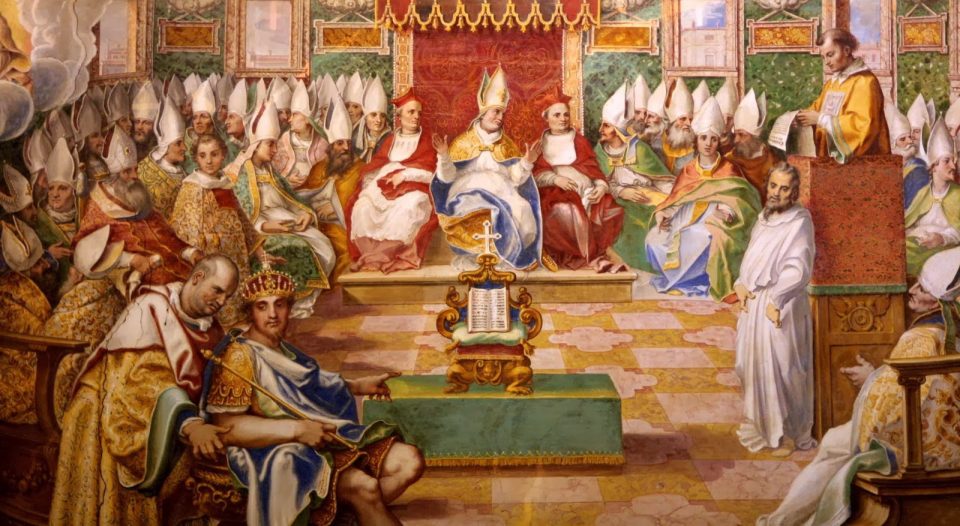
Constantine told them: you are going to stay here until you come up with a solution. And miracle of miracles—they did! With the presence and guidance of the Holy Spirit, who poured great faith and wisdom into such a diverse group of Christian leaders and sometime adversaries, the Council of Nicaea developed the Nicene Creed. And as the bishops and theologians debated the wording of the Creed, they came up with phrases that were inspired by scripture yet borrowed from the thought patterns of their time.
One example of this wording resolved Arius’ controversial claim in favor of Alexander and Athanasius. And so we confess with the Church throughout the world and across the centuries: “We believe in one Lord, Jesus Christ, the only Son of God, eternally begotten of the Father, God from God, Light from Light, true God from true God, begotten not made, of one Being with the Father, through him all things were made.” We could spend a lot of time going into the meaning of all of that—but the basic thing is that these phrases are all trying to find different ways of saying the same thing: that the Son and the Father have always existed as one God for all eternity. Jesus is God in the fullest sense, and therefore worthy of worship, and also able to save us from sin and death, which is what he does for us on the cross. There was never a time when the Father existed apart from the Son (and for that matter, when we follow the Nicene Creed through to the end, there was never a time when the Holy Spirit didn’t also exist along with the Son and the Father). The one God of scripture is the Trinity, a community of three distinct persons who are uncreated and have always existed, being co-equal in divinity for all eternity.
All of this can strain the limits of our brainpower—and that is okay! Because we are not saved by our knowledge, and we’re not saved by our understanding. The Nicene Creed affirms and summarizes what the Bible teaches—we are saved by God alone. And this one God, whom we as Christians know in three persons (Father, Son, and Holy Spirit) is a great mystery. By mystery I mean the ancient Greek definition of mystery—not a puzzle that we will one day solve, but a reality that is so deep that we could spend all eternity mining its depths and never get to the bottom of it. Yet, bubbling up from the bottom of this mystery is a love so pure and so unconditional—a love that became flesh in Jesus Christ for us and for our salvation, to claim us as God’s own beloved children, and to pour the Holy Spirit into our hearts to create faith within us, and carry us deeper and deeper into God’s own heart.
Why is the Nicene Creed important? It was guided into being by the Holy Spirit who worked through Christians and helped them bridge their differences, so that the gospel of Jesus Christ would continue to be preached, and lived, by people just like us. And that’s what has been happening for the past 1,700 years! For that we can join with the very first thing God created, which Proverbs 8 tells us is Wisdom herself; and Wisdom invites us to rejoice and delight with her in all that God has done. Amen.
*for non-scripture quotations see H. Ashley Hall, https://www.livinglutheran.org/2025/03/we-believe-in/