
Sermon for June 29, 2025
Pentecost 3 C
Luke 9:51-62
Rev. Karl-John N. Stone
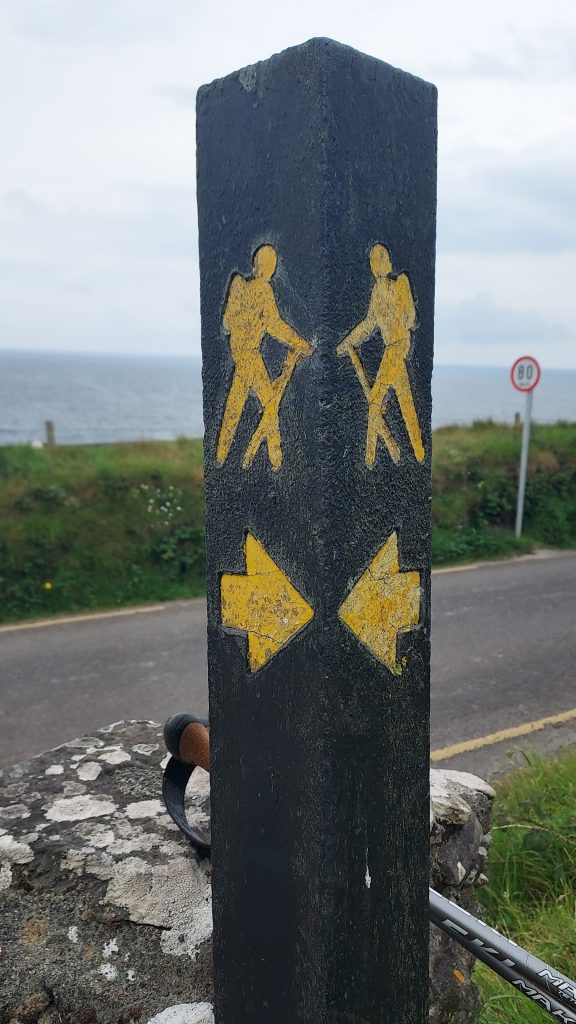
I spent a lot of time looking for the “yellow walking man” picture on signposts while I was in Ireland last month. Whether we walked on country lanes, over stone fences, through pastureland and farms, across the hills, into the valleys, on the beaches, or high atop the sea cliffs, the “yellow man” with his backpack and walking stick reassured us that we were still hiking on the Dingle Way, and hadn’t ventured off course. This trail attracts many hikers and outdoor enthusiasts, and over the course of 4 days we hiked about 1/3 of the 100-mile-long path that makes a ring around the Dingle Peninsula.
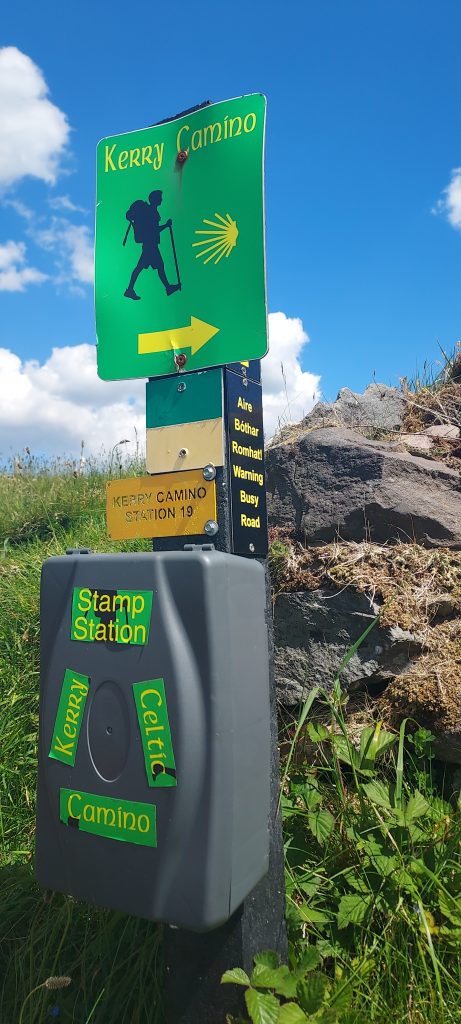
In some places, the yellow man was replaced by a green sign with a black hiker and a yellow scallop shell. This sign let us know that we were on the portion of the Dingle Way known as the “Kerry Camino”. You may have heard of the famous Camino de Santiago de Compostela in Spain, which over 400,000 pilgrims from all over the world walk each year. Well, the Kerry Camino in Ireland is part of that 1,200-year-old pilgrim pathway. For centuries, pilgrims would walk this trail through County Kerry in Ireland to the fishing village of Dingle. From there they’d set sail due south until they landed in Spain; there they would keep walking until they reached the tomb of St. James the Apostle. [www.hillwalktours.com/walking-hiking-blog/ultimate-guide-to-hiking-the-kerry-camino/ ] The scallop shell became a symbol of the Camino, because it was used by the pilgrims to scoop up drinking water from springs and creeks, and a shell with a cross on it was given to them by a priest at the end of their journey—a badge for completing the pilgrimage. The shape of the shell, with many lines coming together at a single point, is interpreted as a symbol of the pilgrims who walked many paths and traveled from many places all around the world—yet they all walked the Camino towards one common goal.
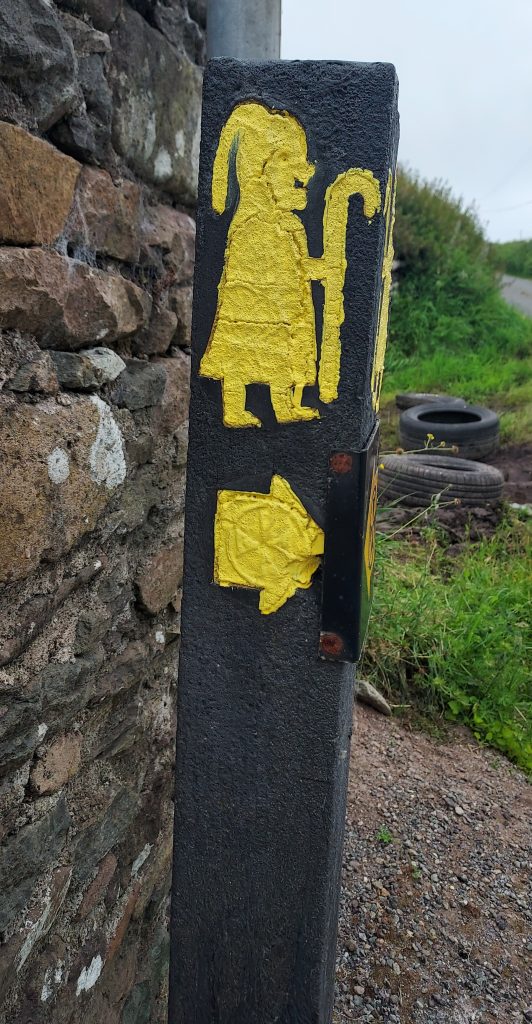
Finally, on our last day, we ventured off the Dingle Way and followed these “Yellow Monk” signposts. The yellow man’s walking stick and backpack were replaced by a shepherd’s staff, cloak, and mullet-style haircut—which is the way ancient Irish monks wore their hair (long on top, shaved on the sides; not the Roman style of being shaved on top and long on the sides). The “yellow monk” signposts told us that we were now walking the ancient “Saints Road” in the western-most part of the peninsula. The Saints Road took us to several important religious and cultural sites, including the 1,000 year-old Gallarus Oratory, which is made entirely of stone and shaped like an upside boat. Oratory means “house of prayer” and it housed pilgrims who stopped to pray while walking to the summit of nearby Mount Brandon where the local hero, St. Brendan the Navigator, had once walked to pray and meditate from the mountaintop.
All of the trails we walked attracted a variety of hikers with a variety of motivations. So what is it that turns a walk into a pilgrimage? Is it the location? The starting point? The destination? The scenery you see or the sites you visit? Is it the people you are with, or whom you meet along the way? All of these go into making a pilgrimage, but you can also have all of those things and never take one step on a pilgrimage. Why is that? What makes a pilgrimage a pilgrimage? It all comes down to your focus. Your intention.
A walk becomes a pilgrimage when you intentionally shift your focus to looking for God, and your intention turns to becoming aware of the presence of Christ. And you do that by setting aside your busy schedule and your obligations and worries for a time, and you allow yourself to slow down. You give yourself permission to be gentle with yourself, as you seek to simply accept whatever you might encounter as a gift from God. And the physical journey you are making is actually a metaphor for the true journey we are all taking by the grace of God—the journey deep into your own heart and soul, where the presence of the living Christ is already waiting to meet you with his own grace, love, forgiveness, and acceptance. Because of that, a pilgrimage can really be done anywhere, as long as you come to it with focus and intention. A focus on Christ’s presence, and the intention of a slowed-down acceptance of God’s gifts.
Jesus was a pilgrim. We see it in today’s gospel from Luke 9: “When the days drew near for Jesus to be taken up” (that is, go to the cross to give himself for our forgiveness and salvation), “he set his face to go to Jerusalem”. Going to Jerusalem meant that he was focused on his intention to carry out God’s plan and to fulfill his mission. And to do that, Jesus would have to walk from the hills of Galilee all the way to Jerusalem—which also meant walking through the land of the Samaritans. But Jesus knew that Jews and Samaritans had a difficult relationship, so he sent the disciples ahead to prepare his way. They went—and were rejected! In their anger, the disciples gave in to the sin that clings so closely to us all, and asked “Lord, do you want us to command fire to come down from heaven and consume them?” They’re basically saying, they hate us so let’s kill them.
Jesus turns and rebukes the disciples. Inflicting violence on their opponents would defeat the whole point of why Christ walked the earth in the first place. The disciples, in their eagerness to prove themselves worthy of following Jesus, quickly lost the focus and intention they needed. But regardless of the disciples’ attitude, Jesus continues his way to Jerusalem. And as a pilgrim, as one who is supposed to accept whatever he encounters as a gift from God, Jesus uses the disciples’ hostility as a teaching moment. Letting go of the desire for revenge against the Samaritans shows that Jesus is going to Jerusalem not only for the disciples’ forgiveness and salvation—but also for the Samaritans’. Jesus is keeping his focus on the big picture—God’s plan of salvation is for all of humanity. Christ has come to save everyone—not just the people who think like you and act like you.
As Jesus continues his pilgrimage, he meets lots of people who support him—but he rebukes them as well! These are some confusing sayings in Luke 9:57-62. Doesn’t Jesus want us to follow him? Wouldn’t he want us to respectfully honor our loved ones who have died? Wouldn’t he want us to say goodbye to our families before going on a trip? Yes, I think he would. But remember that Jesus has just “set his face to go to Jerusalem”. This mission will take a single-minded devotion that even his 12 closest friends will fail to achieve. Yet Jesus offers some guidance, saying “No one who puts a hand to the plow and looks back is fit for the kingdom of God.” It’s a hard saying. Who among us never looks back? But to fully embrace the life of faith means asking Jesus to help us; asking him to give us the focus and intention to keep looking forward; to “put our hands to the plow” so that in the furrow we may plant seeds of faith, hope, and love—knowing that we plant, but only God gives the growth. And the things that God will grow in the future are things that we haven’t even imagined.
In the same way, our own pilgrimage of faith is a journey that asks us to look ahead to the joys of heaven—while also accepting the presence of God in all of life today. And this means we accept (in the way of a pilgrim) that everything we encounter is in some way a gift from God. Whether you’re going or staying, living or dying, in pain or pleasure, in sickness or health—in all things, God leaves gifts for us to uncover and embrace; and when we receive these gifts from God in faith, the Holy Spirit uses them to turn our focus and intention back to Christ.
So, in the spirit of a pilgrim, let me offer you the prayer of St. Brendan, who as a follower of Jesus “put his hand to the plow and didn’t look back”, and who inspired countless pilgrims through the centuries to turn their focus and intention to Christ. Let us pray: O God, “Help me to journey beyond the familiar and into the unknown. Give me faith to leave old ways, and to break fresh ground with You.” Amen. https://www.aletterfromireland.com/have-you-walked-pilgrim-paths-of-ireland/